
A second cleanser can feel like the missing step between a busy day and a fresh face. It can also be an unnecessary repeat of something your first cleanser already does well. The useful question is not whether double cleansing is fashionable, but whether your current method removes what you wear comfortably. That depends on your makeup, the particular sunscreen, the cleanser instructions and how your skin feels afterwards. An elaborate evening ritual is optional; comfortable, consistent care is the aim.
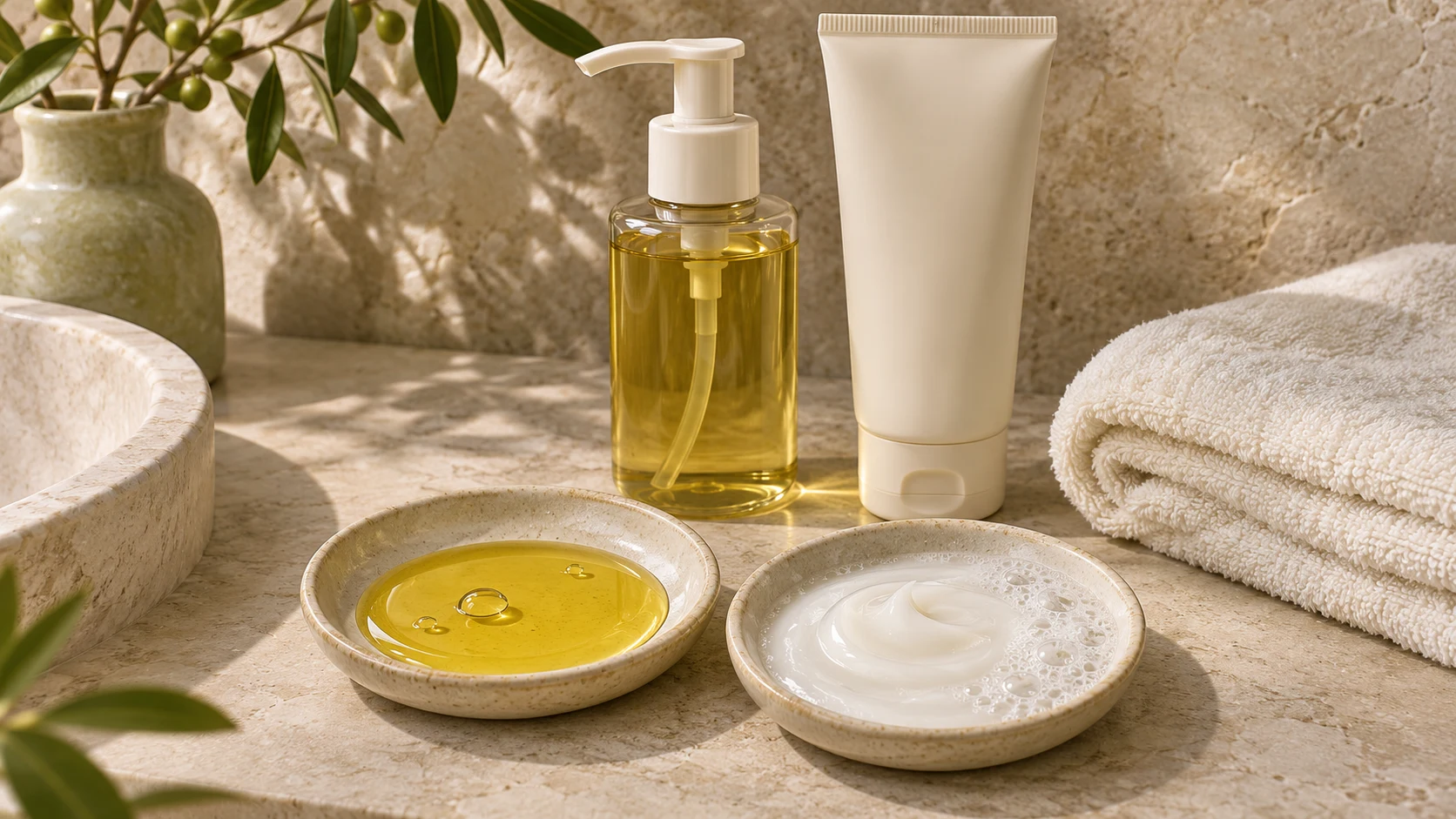
Separate home cleansing from the decision to book
This guide separates the decision to remove resistant products from the decision to book a facial. Those decisions sometimes meet, but they are not interchangeable. A cleansing appointment cannot compensate for a daily routine that repeatedly leaves your face sore, and adding a second wash cannot diagnose persistent bumps or rashes. The following examples are illustrative planning situations, not client records or treatment results. The information is general skincare education, not medical advice or a substitute for assessment of a persistent skin concern.
Start with the job, not the number of steps
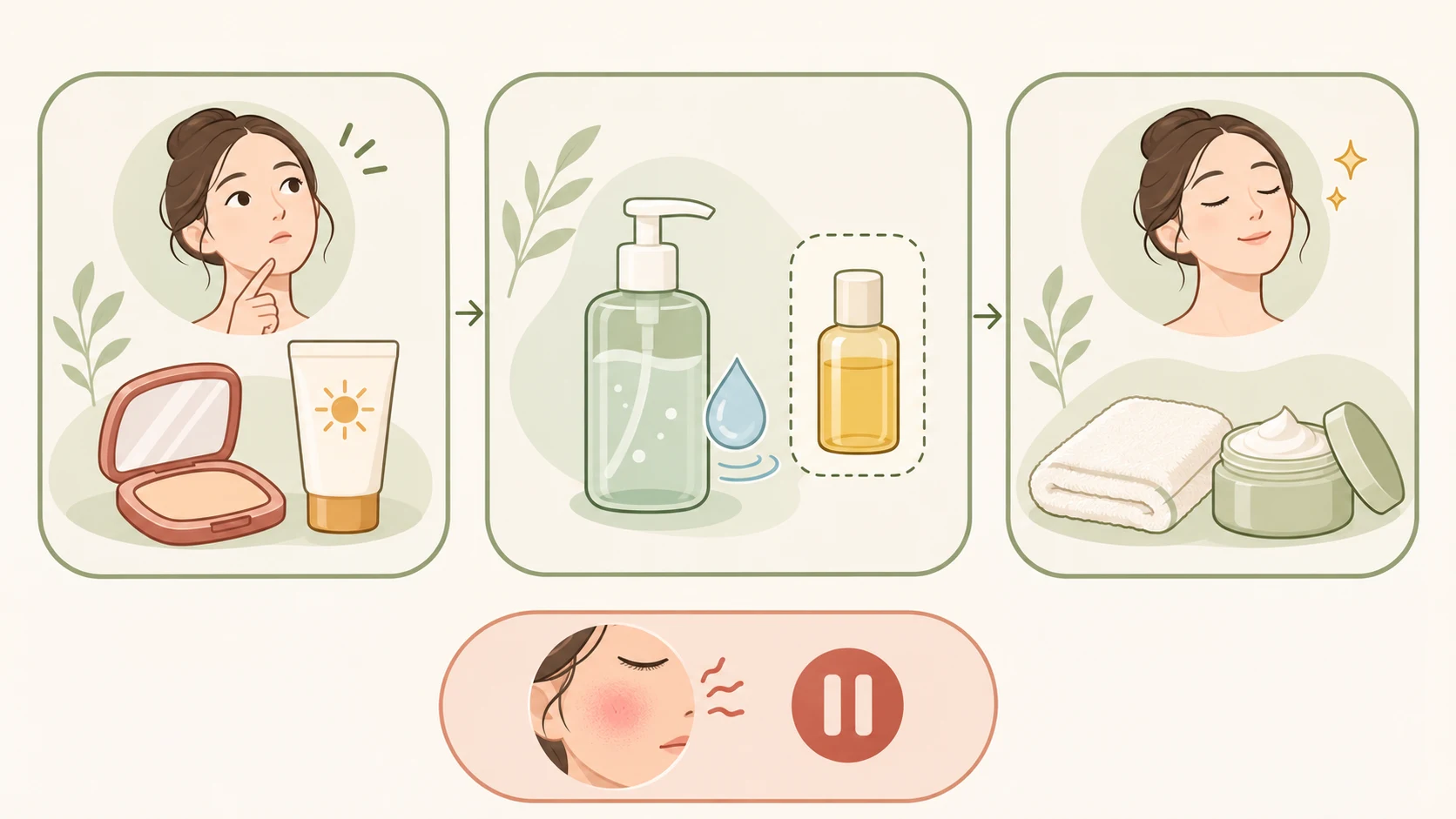
Double cleansing usually means a first removal step, often an oil, balm or makeup remover, followed by a water-based cleanser. It does not mean washing vigorously twice, applying two exfoliating products, or cleansing morning and evening. A single cleansing routine can still be thorough. Conversely, two products can still leave residue if they are unsuitable for the makeup involved or are used against their instructions. Count the jobs being done before counting the bottles on the shelf.
For an ordinary day with products your cleanser removes comfortably, a second step needs a reason. That reason might be a resistant foundation that remains at the hairline after normal washing. It should not be a belief that every trace of natural skin oil is dirty. If the same cleanser removes your daily products and leaves your skin comfortable, keeping that routine is a reasonable decision. There is no need to invent a problem simply because another person has a longer evening routine.
For an evening with long-wear makeup, a separate removal product may make the process easier. The intended advantage is less repeated rubbing with a cleanser that struggles with that particular film. However, the benefit disappears if the first step creates discomfort or the second becomes an aggressive scrub. Treat the method as a practical option with a specific purpose, rather than a higher level of cleanliness that everyone should reach. Your routine can change between a makeup day and a quiet day at home.
What the guidance actually supports
The AAD's November 2026 skin-care guidance recommends a simple foundation of cleanser, moisturiser and sunscreen, gradual introduction of new ingredients and warm rather than hot washing water. It does not establish a requirement for two cleansing products. This is helpful context for resisting an automatic upgrade: a routine should earn its extra steps through usefulness, not complexity. The same guidance identifies changing, itching or bleeding spots as reasons to see a dermatologist rather than trying to wash them away.
Cleveland Clinic's explanation of washing frequency distinguishes makeup removal from everyday washing. It discusses double cleansing for makeup wearers and warns that unnecessary repetition may be drying. It also allows a water-only morning wash for some dry or sensitive skin, with cleanser in the evening. These are general recommendations, not a trial proving that one schedule is best for every face. The practical implication is to individualise frequency and removal method instead of combining every recommendation into one intensive routine.
A 2026 review of gentle cleansing technologies explains that cleansing performance and tolerability depend on formulation. The accessible abstract describes surfactants that help disperse oils and discusses technologies designed to reduce irritation. Our access was to the abstract, not the full methods or disclosures. It does not establish that any cleanser sold as gentle will suit you, nor that double cleansing is superior. Product-specific findings cannot be transferred to an unnamed balm, a facial-bar service or a whole category of skin types.
Why removal and comfort can pull in different directions
Water and oily residues do not always mix easily. A cleanser is formulated to help loosen and disperse material so it can be rinsed or wiped away as directed. But skin is not an inert countertop: the same routine also contacts its surface, and repeated cleansing may leave it dry or uncomfortable. More effort is therefore not automatically a better result. The formulation, amount, contact time, water temperature and friction all contribute to the experience, alongside the products being removed.
Think about the difference between dissolving a stubborn cosmetic film and polishing a surface. A remover intended for that cosmetic can reduce the need for rubbing. A brush, rough cloth or gritty scrub introduces a different action and should not be treated as an essential second cleanse. Exfoliation and cleansing are separate choices, even when a product combines them. If a cleanser already contains an exfoliating ingredient, adding another active wash may duplicate exposure without addressing the original removal problem.
The aim is comfortable removal, not a squeaky feeling, a colourless cotton pad after endless wiping, or a face that stays completely matte. None of those home observations measures barrier function or proves a pore is empty. A cleanser can also leave a sensory finish by design. If that finish bothers you, ask whether the product suits your preference and routine; do not assume it is contamination requiring repeated washing. Ordinary observation can help guide a choice, but it cannot replace a clinical assessment.
Oil, balm, micellar water and a single cleanser
An oil or balm may be useful when your makeup needs a remover of that type. Follow the specific instructions: some formulas are applied to dry skin and then mixed with water, while other products work differently. Do not substitute a kitchen oil and assume it will rinse like a formulated cleanser. Texture alone does not tell you how well a product emulsifies, which ingredients it contains, or whether you will tolerate it. Choose according to the intended use and your history of reactions.
Micellar water is another possible removal step, especially when a particular makeup product recommends it. Its convenience does not make rubbing harmless. Use it according to the label, avoid repeated forceful wiping and check any instructions about rinsing. If removal around the eyes is difficult, use a product specifically intended for that area rather than carrying an unsuitable facial wash towards the lash line. Persistent eye irritation deserves appropriate medical advice, not a more determined cleansing technique.
A single rinse-off cleanser may be the simplest satisfactory option. It can be chosen for the actual products you wear, rather than because a long routine seems more luxurious. Foam level, price and packaging do not independently demonstrate effectiveness or comfort. A rich-looking product can still contain an ingredient you react to; a modest product can still do its intended job. If your routine works, a professional visit should help clarify remaining cosmetic goals rather than persuade you that comfortable home care is insufficient.
Sunscreen removal should not undermine sun protection
Do not reduce sunscreen use to make evening cleansing easier. The FDA's sunscreen guidance explains that water resistance is limited and that no sunscreen is waterproof or blocks all ultraviolet radiation. The AAD recommends broad-spectrum SPF 30 or higher alongside shade and protective clothing. The FDA page describes a lower minimum SPF threshold in its US guidance; these are different recommendations, not evidence that higher protection is unnecessary. Follow a suitable sunscreen's directions and local clinical advice.
Removal is a formulation-specific question. A sunscreen's water-resistance claim concerns its protection during water exposure under specified conditions; it is not an instruction to scrub at night. Read the manufacturer's removal advice when available. If your cleanser appears to struggle with a particular product, change the removal approach thoughtfully rather than treating every sunscreen as equally resistant. Neither a visible cast nor its disappearance reliably tells you how much protective film remains, and a home mirror cannot certify complete removal.
Keep the decision manageable. Identify the sunscreen you actually use, note whether you also wear foundation, and ask the manufacturer about compatible removal if the label is unclear. Avoid building a complex method around fear of invisible residue. There is no justification here for skipping daytime protection, repeatedly washing until skin hurts, or buying a device to prove your face is clean. A tolerable evening routine and consistent sun protection should support each other, not become competing priorities.
When a second cleanse is the wrong experiment
If your face is currently burning, persistently itchy, cracked, markedly inflamed or newly swollen, adding another cleansing product is a poor troubleshooting strategy. Stop the suspected new product and seek appropriate advice when symptoms persist or are significant. Postpone elective facial treatments while an unexplained reaction is active. Severe swelling with breathing difficulty or other signs of a serious allergic reaction requires urgent medical help. A facial bar should not be used to diagnose the cause or to test how much irritated skin can tolerate.
The FDA's information on cosmetic allergens emphasises ingredient review and avoidance of known allergens. It also notes that US terms such as hypoallergenic or for sensitive skin do not have a federal definition guaranteeing suitability. That is a US labelling context, not a statement about every country's law. In practical terms, reassuring front-label language should never override your own reaction history. A suspected allergy may require clinician-directed testing; a quick informal trial does not rule it out.
Be particularly cautious when recent procedures, prescription treatments or an established skin condition already come with cleansing instructions. Follow the treating clinician's advice rather than adding this guide as another protocol. Do not stop a prescribed medicine to prepare for a facial without discussing it with its prescriber. Disclose relevant products and procedures when asking about an appointment. Pregnancy, allergies or ongoing treatment may change suitability, and a service name alone cannot answer those questions. There is no universal waiting interval that can safely be inferred here.
Make a useful record before changing anything
Before replacing products, make a short inventory: the cleanser, any remover, sunscreen, makeup and active treatments used on the same day. Record when discomfort appears and whether it follows washing, a leave-on product or another change. Include ordinary details such as a hot shower or repeated towel rubbing. This is a practical conversation aid, not a diagnostic diary. It helps avoid attributing everything to a single ingredient when several aspects of the routine changed together.
Change one manageable element at a time when your skin is comfortable enough to experiment. For example, investigate a compatible makeup remover while keeping the rest of an established routine steady, rather than introducing a balm, acid wash, brush and serum together. Follow product instructions, and stop if irritation develops. There is no scientifically justified universal trial period for every cleanser and every reaction. Immediate comfort also does not guarantee that a product will remain suitable over repeated use.
Bring product names or photographs of labels to a discussion about a facial. Describe what you want to solve in observable terms: foundation remains around the nose, washing leaves the cheeks tight, or your current routine is inconvenient. These are more useful than asking for a complete detox or perfectly empty pores. If a clinician has already given you a diagnosis or restrictions, share that information directly. The aim is to choose a feasible next step, not to collect as many treatments as possible.
Two illustrative decisions about an Anywell visit
Illustrative scenario one: an adult wears long-wear foundation for work, removes it with repeated rubbing, and wants help choosing a more comfortable cleansing routine. Their skin is currently calm, with no unexplained rash or recent procedure. Anywell's published menu lists Cleansing Ritual and Pores Control. These are options to ask about, not proof that either includes a particular remover, extraction method or double-cleansing protocol. A useful enquiry explains the daily makeup problem and asks what each service actually involves before choosing.
The reason to consider a visit in that situation is a defined cosmetic care goal and a chance to clarify a suitable service. The reason not to book is equally clear: if the problem is resolved by a well-tolerated home remover, a treatment is optional. If painful lesions, persistent redness or a suspected allergy are present, medical advice may be the better next step. No promised pore reduction, acne outcome or universal treatment frequency follows from the service names.
Illustrative scenario two: an adult has comfortable skin, wears little makeup and enjoys a quiet facial ritual, but assumes double cleansing is necessary before booking. Anywell's menu also lists Face massage STRONG / RELAX. They can ask whether RELAX suits their preference and circumstances; there is no need to invent a cleansing problem to justify an interest in relaxation. They should defer if massage conflicts with medical or post-procedure advice, or if their skin becomes inflamed. Relaxation is a distinct goal from treating a skin disorder.
Ask what the appointment will actually contain
The current Anywell services page is the starting point for comparing named options. It lists Cleansing Ritual, Pores Control, massage choices and hydration-related options. It does not provide enough detail to infer every product, device, extraction step or individual contraindication. Ask about those points directly. If your central concern is removing makeup at home, explain that before selecting a treatment simply because its name sounds intensive. A more expensive or longer option is not automatically the relevant one.
A helpful enquiry can be concise: describe your current routine, the specific cosmetic goal, any known allergies and relevant recent procedures, then ask which listed service might fit and what should be postponed. Ask whether the proposed care contains exfoliation, pressure or ingredients that overlap with what you already use. The answers should guide the choice. This article does not certify a particular protocol, practitioner qualification or outcome, and it does not establish that every service is suitable for sensitive skin.
If you would value that clarification, contact Anywell with your routine and questions before choosing an appointment. The public contact page offers phone contact and links to online booking. Availability and suitability still need confirmation through the business. An enquiry is useful when it resolves uncertainty; it should also leave room for the answer that home care is sufficient, the requested technique is unavailable, or treatment should wait. An informed decision can reasonably be a decision not to book.
Keep the next evening straightforward
After a facial, use the specific aftercare instructions supplied for the treatment actually performed. Do not assume that every service has the same restrictions or that this article overrides advice connected to a procedure. Ask before leaving whether your regular remover, cleanser and active products can be continued, and what symptoms should prompt a call. If the advice is unclear, clarify it rather than filling the gap with a generic schedule found online. The safest routine depends on what was done and how your skin responds.
For ordinary home cleansing on comfortable skin, make the sequence easy to repeat: remove the products that require removal, rinse as directed, dry gently and use a familiar moisturiser if appropriate. Avoid adding a scrub to celebrate how clean the skin feels. Do not introduce several new products at once immediately after changing your cleansing method. The objective is to notice whether the change made daily care easier and more comfortable, not to provoke a dramatic transformation overnight.
If new discomfort develops after a visit, document the timing and contact the provider; seek medical care for persistent, worsening or concerning symptoms. Do not repeatedly cleanse in an attempt to reverse a reaction, and do not cover significant irritation with more active products. Keep the names of products used if they are available, as this may help subsequent assessment. A temporary cosmetic improvement is not proof that a routine is suitable long term, just as a single uncomfortable evening does not identify a specific diagnosis.
Judge success without chasing a perfect face
Use a small set of practical observations: does the intended makeup come off without repeated force, does your face feel comfortable afterwards, and can you maintain the routine? Keep expectations close to that task. Cleansing can change surface appearance by removing cosmetics and residue, but it does not permanently lift tissue, eliminate pores or replace treatment for a skin disease. If a promise exceeds the job of the product, ask what evidence supports it and whether that evidence concerns the same formulation and population.
The evidence reviewed here does not settle a universal contest between single and double cleansing. General guidance, a formulation-focused review abstract and regulatory safety information answer different questions. None establishes the best Anywell treatment for an individual reader. The useful synthesis is narrower: start with a clear removal need, preserve comfort, respect product and clinical instructions, and seek clarification when symptoms or service details are uncertain. This leaves room for personal preference without turning preference into a medical claim.
Conclusion: the Anywell way
Double cleansing is an option to evaluate, not a standard of personal care you must achieve. Keep a comfortable single cleanse when it does the job; investigate a suitable removal step when resistant makeup creates a practical problem. If your skin is reacting, resolve that uncertainty before adding elective care. For broader context, explore our skin barrier facial guide. When a professional visit would serve a clear cosmetic or relaxation goal, use Anywell's contact page to ask about the relevant listed service and appropriate preparation.
FAQ
Does everyone need double cleansing?
No. A comfortable single cleanser may be enough. Consider a separate removal step when the products you wear create a specific removal problem.
Is double cleansing the same as exfoliation?
No. Removing cosmetics and exfoliating skin are different tasks, even if a product combines them. Do not automatically add acids or scrubs.
Should I skip sunscreen to simplify cleansing?
No. Maintain appropriate sun protection and choose a compatible removal method according to product instructions.
Can I book a cleansing facial with an active rash?
Postpone elective care and seek appropriate advice for an unexplained, persistent or significant reaction.
Does Anywell offer a specific double-cleansing protocol?
The public menu lists Cleansing Ritual and Pores Control, but does not document every step. Ask Anywell to confirm what is included and suitable.