
A home LED face mask and a facial appointment can both appeal when your skin looks less fresh than you would like. Yet they ask different things of your time, budget and expectations. A mask is a device with a defined intended use and a repeated home routine. A facial is a service whose value depends on its actual steps, your comfort and the reason you booked. Neither should be chosen simply because the other feels expensive, fashionable or inconvenient.
Define the result before choosing the tool
This guide asks a practical question: when is a home light device worth investigating, when might a facial visit fit better, and when is neither the right next step? It considers recent research without turning laboratory findings into promises. The examples are illustrative decisions, not client testimonials. This is general educational information, not medical advice, a device prescription or a substitute for assessing persistent symptoms.
Begin with a sentence you could explain without a beauty vocabulary: my skin feels uncomfortable after washing; I want a restful appointment; I am curious about gradual changes in fine lines; or I have a patch that keeps changing. These are different requests. Putting them all under “glow” makes it too easy to buy a solution before identifying the problem. A useful choice starts with what you notice, how long it has been present and whether there are symptoms as well as an appearance concern.
Next, separate the desired experience from the desired visible change. Wanting someone else to take care of your face for a while is a valid preference. Wanting a device you can use privately is also valid. Neither preference establishes a biological advantage. An enjoyable ritual may justify its place in your week without becoming evidence that wrinkles have changed, and a technically interesting device may still be a poor match for someone who dislikes maintaining equipment.
Finally, include the option of doing nothing new. If your routine is comfortable and you do not have a specific concern, there is no requirement to add a mask or an appointment. Write down what would make an intervention worthwhile, and what would make you stop. This creates a personal decision rule before an advertisement supplies one for you. It also makes a conversation with a practitioner clearer: you can describe a goal rather than request every available treatment.
What the recent LED research actually tested
An October 2026 exploratory study followed 50 women aged 49–65 for 56 days using a red and near-infrared mask together with a cream. Investigator scores and participant ratings improved from baseline. However, everyone received the combination: there was no clinical mask-only, cream-only or sham group. Most participants had phototype III. Clarins funded the study, and three authors were employees. These details limit attribution, generalisation and independence; they do not erase the observations.
The accompanying laboratory experiment used skin from six donors. Biological markers in isolated tissue are different outcomes from an everyday face looking better. The clinical study also did not establish how long changes last after stopping. Its publication date was 2026, while the experiments took place in 2024. The useful lesson is to examine the tested combination, population and comparator before treating a new paper as a shopping recommendation.
Independent context comes from a 2026 scoping review of home dermatologic devices. Its accessible abstract describes evidence that varies by device category and indication, including moderate evidence for LED in facial rejuvenation. We could assess the abstract, not the complete methods or individual studies. That supports caution about sweeping claims; it cannot rank the mask in your basket or prove equivalence to a facial. A review category and a specific consumer purchase are different levels of evidence.
Understand light without turning a mechanism into a promise
In plain language, photobiomodulation means using light to influence biological activity. Red and near-infrared light are investigated for effects on skin cells and processes associated with appearance. Cleveland Clinic's September 2026 explanation describes potential benefits with consistent use while cautioning against expectations of dramatic or overnight changes. A plausible mechanism is a reason to investigate an intervention, not a guarantee that every device will produce a visible result for every person.
For a reader, the distinction becomes easier with three separate questions. What is the device intended to do? What did a study actually measure? What change would matter to me? A technical answer about cell activity does not answer the third question. Someone who wants a peaceful break from a demanding week may care more about the experience. Someone deciding about fine lines may need a discussion of evidence, tolerability and alternatives with a dermatologist before making a purchase.
Do not use the brightness of a mask, the number of coloured settings or the drama of a promotional photograph as a substitute for that discussion. Those features are visible; the quality of evidence is less visible. Ask for the exact model and its instructions rather than a general statement that light technology is scientifically supported. If a seller cannot distinguish the device from the wider category, you still have a question to resolve. You do not have a reason to increase the intensity yourself.
Compare a home mask, a facial and ordinary home care
A home mask offers control over where you use it and whether its routine fits your day. In return, you take responsibility for following the instructions, preparing and cleaning the device, checking restrictions and noticing problems. It does not provide a conversation about a newly developing symptom. The practical advantage is convenience only if you can actually use it as directed. A device left in a drawer has little practical value, however persuasive its specifications looked at purchase.
A facial appointment offers a scheduled service and the opportunity to explain your preferences before it begins. The content matters more than the word facial. Massage, cleansing and hydration-oriented services should be compared by their confirmed steps and suitability, not treated as interchangeable versions of LED. Ask what will touch your skin, whether there are optional steps, and what happens if you prefer a simpler treatment. The published evidence reviewed here does not establish that an Anywell facial outperforms a home mask, or the reverse.
Ordinary home care is a third option. You may decide that a clear, manageable routine is enough for the present concern. The AAD's November 2026 guidance emphasises gentle cleansing, moisturiser, sun protection and gradual introduction of products. That is a foundation, not a promise that basic products solve every condition. If the concern remains unexplained, seek assessment instead of continually adding products. For help organising daily habits, our home-care and facial planning guide provides a separate routine-focused discussion.
Read a device claim before paying for it
Start with the exact intended use. “Skin wellness” is broader than a statement about a particular appearance concern, and a device suitable for one purpose is not automatically suitable for another. In the United States, the FDA distinguishes device approval, clearance and registration. Many moderate-risk devices use the 510(k) clearance pathway based on substantial equivalence. Registration alone is not approval. These US categories do not establish local availability in Ukraine or guarantee your personal result.
A concrete example is the FDA record for K252093, which ties a named mask and different light modes to specified indications. It also lists technical comparisons and performance testing. It is not a recommendation to buy that product. Its value here is methodological: a meaningful claim can be traced to a model and purpose, rather than floating free as a general badge beside any image of a glowing mask.
Before buying, obtain the manual in a language you understand. Check its restrictions, eye-protection directions, cleaning method, electrical requirements, support contact and return terms. Ask what happens if the fit is uncomfortable or the instructions are unsuitable for your circumstances. Do not invent a timetable from someone else's video. You should be able to explain how this particular purchase would fit your life without borrowing a competitor's study, a different model's clearance or a promise of results that the documentation does not make.
When to pause and ask for medical advice
Photosensitivity changes the decision. Cleveland Clinic's current advice flags light-sensitive disorders and medicines that increase sensitivity as reasons to consult a dermatologist before starting. Bring the exact device information and a medication list to the relevant clinician or pharmacist. Do not stop a prescribed medicine to make a beauty device fit. Pregnancy, a recent procedure, an eye condition or an unclear medical history also deserves individual advice rather than reassurance inferred from a general article or an absence of warnings in an advertisement.
For darker skin tones or a history of unwanted pigmentation, ask specifically whether the evidence and instructions apply to you. The narrow phototype range in the recent combination study cannot answer that question for everyone. This is a reason to seek a more relevant assessment, not to declare all light devices safe or unsafe for an entire group. The same care applies when redness or sensitivity has never been diagnosed: a cosmetic label is not an explanation of what is happening.
Postpone elective experimentation if your skin is actively painful, broken or unexpectedly inflamed. A persistent rash, a changing lesion or a reaction that is worsening needs appropriate medical assessment. Stop device use if it causes concerning symptoms and follow the manufacturer's safety directions; seek prompt care for eye pain, visual changes or a significant burn. A facial appointment should not become a workaround for a device-related reaction. Tell the provider what happened before arranging any further cosmetic treatment.
Two illustrative decisions with different reasons to visit
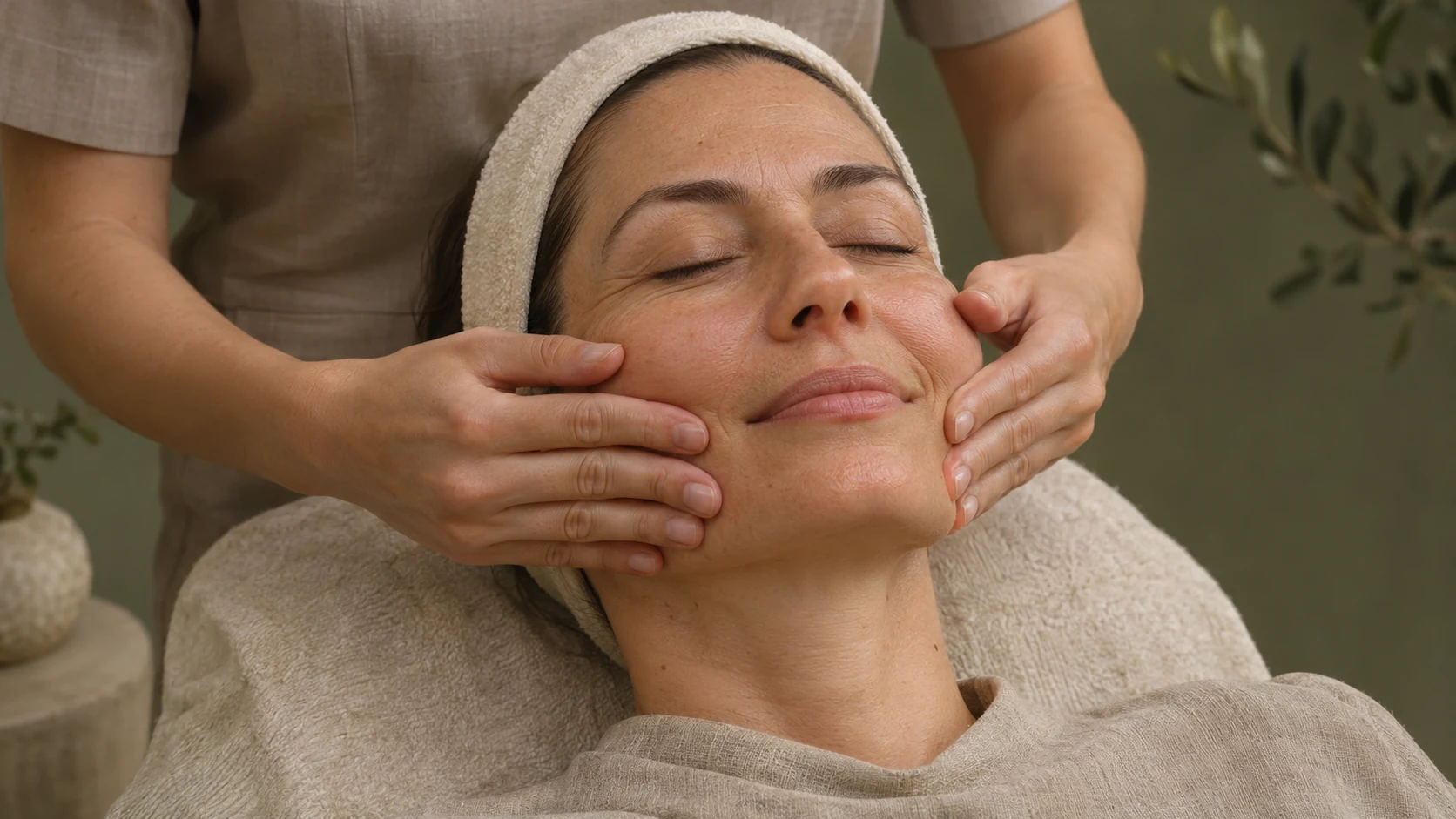
Consider an illustrative client whose skin is comfortable but who is disappointed by how tired she looks after demanding workweeks. She enjoys facial touch and wants a restful experience, while a mask advertisement has made her wonder whether she should buy technology instead. Anywell's menu lists Face massage STRONG / RELAX. She can ask about the RELAX option, products used and appropriate pressure. The reason to discuss this service is her preference for a hands-on appointment, not a claim that massage recreates a light device's mechanism.
She should not book merely because a salesperson has made normal skin texture feel unacceptable. She should also defer if she has pain, active inflammation or restrictions from a recent procedure. If her real aim is evidence-based management of a persistent skin condition, she needs medical guidance first. A good outcome from the enquiry could be a suitable appointment, a later date or a decision that she does not currently need a service.
Now imagine a second illustrative client with comfortable skin who wants to discuss hydration-oriented care before investing in a home device. Anywell lists Meder Hydration / Lifting and Dermadrop HYAL10. Those names provide specific options to ask about, but they do not prove a protocol, suitability or result. She can describe what she wants, list products she already uses and ask which option, if any, fits. If simpler home care meets her needs, she can keep it. If ordinary products sting persistently, or a rash is present, she should postpone the cosmetic booking and seek assessment instead.
Use the actual Anywell menu to ask better questions
The Anywell services page offers a useful starting point because it names the options. For this decision, the relevant enquiries concern Face massage STRONG / RELAX for a preference for massage, and Meder Hydration / Lifting or Dermadrop HYAL10 for a discussion about hydration-oriented care. These are menu references, not a prescription. Confirm current availability, the treatment steps and whether they suit your circumstances directly with the team before booking.
An LED service was not listed on the menu checked for this guide. Do not assume that a facial booking includes light therapy, or that the presence of other technology establishes access to a particular device. If LED is specifically what you want, ask directly rather than selecting an unrelated service and expecting it to be added. Likewise, a name containing “lifting” should prompt a discussion of realistic appearance goals, not an expectation of permanent structural change.
You can contact Anywell with your goal and current routine and ask which listed option is worth discussing. Useful questions include whether the proposed service involves exfoliation, pressure, heat or products you have previously reacted to; what can be omitted; and what aftercare will be needed. The aim is a clear answer before a purchase. If the available service cannot address your preference within appropriate limits, keeping your existing routine or choosing a different kind of professional advice is sensible.
Prepare a useful appointment or device discussion
Make a short inventory rather than arriving with the vague description “sensitive skin.” Note the products you use, any prescribed topical treatment, recent procedures, known allergies and what you mean by discomfort. Does it happen during washing, after a particular product or without an obvious trigger? You do not need to diagnose yourself. A clear account helps the professional decide what questions remain, whether a cosmetic service is appropriate and which concerns fall outside that service's scope.
If you already own a mask, bring its model name, manual and recent use pattern to the discussion. Include whether you have changed any products at the same time. A provider cannot meaningfully assess a combination described only as “red light and serum.” Ask who should advise on compatibility if the manufacturer instructions and another provider's directions seem inconsistent. Do not improvise by shortening a session, adding a protective cream or changing a setting unless the relevant instructions actually support that adjustment.
For a planned event, disclose the date and whether you have tried the proposed service before. A familiar appointment and a new device are different uncertainties, and neither needs to be introduced under deadline pressure. Our pre-event facial guide explores that separate timing decision. Confirm any instructions for preparation with the provider. There is no universal pause interval for every acid, retinoid, injectable or procedure, and a general skincare article should not replace the treating clinician's directions.
Keep the period afterwards easy to interpret
After a facial, ask for instructions tied to what was actually done. A massage-only visit and a session involving exfoliation do not automatically share an aftercare plan. Clarify which products to use, which to pause, when to contact the provider and who should assess a reaction. Write down the answer if several steps are discussed. If you also use a home device, ask specifically when it can be resumed; do not assume that a procedure described as gentle makes every combination appropriate.
For home LED use, follow the exact device instructions for preparation, eye protection, session length and cleaning. Do not replace required protection with an improvised accessory or add sessions to compensate for a missed day. Keep track of changes in comfort as well as appearance. A routine that becomes unpleasant is not improved by treating discomfort as evidence that something powerful is happening. If there is a problem, stop and obtain advice appropriate to the symptoms and device.
A practical home-care example is to keep the products you already tolerate while you clarify one new intervention. Avoid adding a new mask, several unfamiliar serums and an intensive facial at the same time. This is a way to make observations more interpretable, not a clinical experiment or a guarantee against reactions. Maintain everyday sun protection. If the goal is hydration or comfort and your simple routine already supplies it, there may be no reason to add another step after the appointment.
Judge value by fit, follow-through and honest limits
Compare the total commitment, not just the first price you see. For a device, consider the time required by its own instructions, cleaning, storage, comfort and access to support. For an appointment, consider travel, preparation, the service itself and any aftercare. A lower apparent cost per use is not useful if you would not follow the routine. Equally, a premium setting alone does not answer whether the service matches your goal. Ask for the current price directly rather than relying on an old screenshot.
Choose a modest way to evaluate your decision. You might note whether you enjoyed the experience, whether your routine remained comfortable and whether the change you hoped for was visible enough to matter to you. If you take photographs, use similar lighting, distance and expression and avoid filters. Personal photographs can help you notice patterns, but they cannot prove a mechanism or distinguish all the effects of products, seasons and other changes. You are deciding whether something fits your life, not conducting a clinical trial.
There is also value in a clear stopping decision. If expectations have changed, the equipment is inconvenient or you cannot resolve a safety question, you can pause without treating the purchase as a commitment to continue. If a facial did not meet your preferences, explain what felt unsuitable before booking again. A responsible skincare plan leaves room for ordinary skin, changing priorities and professional advice. Its quality is not measured by the number of devices or appointments it contains.

Conclusion: the Anywell way
A home LED mask is worth considering only with a specific goal, suitable instructions and realistic expectations. A facial visit may make more sense when you want a confirmed hands-on service and can explain what you hope to experience. Neither replaces medical assessment, and neither is mandatory for well-cared-for skin. If a visit fits your priorities, ask Anywell about the relevant options on its current menu. Share your routine, preferences and any restrictions before choosing. A useful next step is one you understand: why it fits, what remains uncertain and when to wait instead.
FAQ
Can an LED face mask replace a facial?
They serve different goals. A device has a specific intended use and home routine; a facial provides its confirmed service steps. The evidence reviewed does not establish equivalence or superiority for an Anywell facial versus a home mask.
Does Anywell offer LED light therapy?
LED was not listed on the services page checked for this guide. Ask the team directly about current availability; do not assume another facial includes LED.
How often should I use a home LED mask?
Follow the instructions for the exact model and any clinician advice. Do not copy a study schedule or another device routine, and do not add extra sessions to compensate for missed use.
What does FDA-cleared mean for a mask?
For many moderate-risk devices, clearance uses the 510(k) substantial-equivalence pathway for specified indications. It differs from registration and does not guarantee your result or establish local availability.
When should I postpone both a device and a facial?
Postpone elective experimentation for unexplained pain, broken skin, active inflammation or a worsening reaction. Seek medical assessment for persistent symptoms or changing lesions and advice on photosensitive conditions or medicines.